In Belgium

Halfway through a ten-day house exchange, and it’s a rest day, sitting around the house listening to the rain. Rest days are much to be enjoyed following days of getting out and about, either into the melée of Brussels or the frantic road system. Rest days renew the dissipated spirit, refuel the knackered body, prepare for the affair of the holiday to begin again. You might have got the impression that I quite like them.

It might  a bit unfair to rough up the habits of Belgian drivers for they are not quite as the French. Within minutes of entering the roads you have a car up your backside as you obey the very reasonable 50 km suburban speed limit. Not so the locals, who treat speed limits, unless policed, as reference points from which to indulge their boy-racer persona. I was wrong, they are as bad as the French.

Brussels has had a bad press, largely due to their having torn down so much of their architectural heritage in the 1960s. Despite that, in parts it has a lovely Parisian feel, supported beautifully by the predominant language of French at which we are not bad, at least ordering food, buying stamps and the like. There are rewarding quartiers to explore, sinful beer to try and don’t you just love the transport: efficient and cheap, at least the latter beating London. Best of all is coming home to an exchange-house that clasps you unto it, sets you down in the quiet, soothes the fatigue of older age.

Yesterday we drove to Leuven, drove rather than on the tram/train/bus as planned, not only for Suzanne, who has attempted too much after her operation, but also for me with this blasted plantar fasciitis that has persisted for months. Appearing in the square above the car park we were greeted with one of the modern sounds of summer: the banging together of racks of chairs preparing for a rock concert. Another victim of the wars (it’s beginning not to matter which) when the Germans razed lots of the old town for no apparent purpose, Leuven is the country’s oldest university town (1425).

Towards the end of the stay, we visited the town museum where I expected my eyes to glaze over with exhibits of bits of Flanders cloth or spiky mediaeval helmets. Instead, your 10 euros bought four floors of weird arrangements of children’s blocks on tables, pointless films of Indian dancers, pictures (and not many of those) of bits of rope or hairy carpet, and most disconcerting of all a three-act play with two child-robots talking in an American accent to projected films of pole dancers. We did not stay beyond the first act.

_________________________

(Image: https://mleuven.be/en)



Free Beer

The Dublin Jack on Lan Kwai Fong in Hong Kong is patronised mostly by those seeking home-reminding pints of draught bitter and you-know-what stout. Philip, whom I had just met at a client’s, took me there on a warm April evening in 2002. He was interesting, not only because he was a young techhead with ever-changing life objectives – both qualities beyond me – but also have you ever met an Ulster-accented Chinese man? Well, he  was your man.

The pub doors were bursting, drinkers of all ages, sex and colour spilling on to the pavement. Entry was guarded by a young Irishman in a white shirt, tie and black trousers. Hands up, he stopped me.

‘Would you be having an invite?’

‘Pardon?’

‘A private party it is, in there, and only by invite.’

‘Well, we don’t have one but this is a pub, we’re bloody thirsty, and we have come a long way.’ Two out of three, but he didn’t know that, so cross fingers.

‘In that case, you must be going in. And the beer’s free,’ said the guard, looking to and fro in fear of witness to such dereliction of duty.

Free beer? And such was the case, you only had to jostle your way through the press to the counter for ready-drawn Kilkenny or Guinness, sweep off one of the many foaming glasses, and hey presto!

Outside as I handed over a pint, I asked Philip, ‘Is this a dream?’

Unblinkingly, he accepted this unheard-of occurrence phlegmatically. ‘What do you mean?’

For all his Belfast brogue he was at heart Chinese, expressionless even in the face of serendipitously gratis grog. But for me, whilst we supped outside in the tropical evening and our glasses emptied, I pondered about whether I could get back in to this Shangri-la.

‘Do you think we can try it on again?’ I asked him, who had been drinking alongside me in more or less silence.

‘Why not?’ Which was about as far as his excitement got.

‘I’ll go,’ I replied, even though it was his turn.

Barring the way was a different Hibernian, a little older, but again with the white shirt and business, ‘Would you be having an invite?’

‘Er, I was in there a little while ago.’

‘Sure, in that case, I must have let you in before.’ Yes, that was exactly what he said.

And so the beer flowed free for Philip and me, and at a might-have-been fifty Hong Kong bucks a pint, it was among the sweetest I ever tasted.

Some hours later, I took the night flight home to Sydney. I never saw Philip again and like me, I don’t suppose he came across free Guinness again.

94314_md_1.jpeg


Mum and the Snake

While Dad fought in the Korean War, and when I was 9, my mother and my brother lived in the Highlands of Scotland. Strathpeffer (pop. 1,500) was and is an old Victorian spa town whose imposing Highland Hotel was commandeered by the army in WWII for army families, many still billeted there in 1953. It had a sweeping, varnished staircase up which I once saw a man in brown overalls carry a tiny coffin; it had spacious grounds with rhododendron bushes where I played; and my mother would gather other children from the hotel and take us walking up into the mountains. Like the Pied Piper, Mum would lead us joyous kids along tracks, through woods and beside clear-running burns. Once on a narrow path we came across an adder, the only venomous snake in Britain. I can see her now, worried sick for us, waving her flock behind her, raising a rock above her head, crushing the poor reptile to death.


Birthday Party

It’s a town in Lancashire, population 79,000, known since the Middle Ages for cotton spinning, black puddings and now Metrolink, a train that becomes a tram once it enters the nearby city of Manchester. Auntie Alice and I once travelled to and from Old Trafford on this system in 1993, even right behind Warne when he bamboozled Gatting first ball of the series. One of its famous sons, Sir Robert Peel, founded the Metropolitan Police and sadly the Conservative Party. Another of these sons was my father, born 1923 around the corner from the Bensons Sweet factory. And he, indirectly, was the reason that we drove to Bury one recent Sunday.

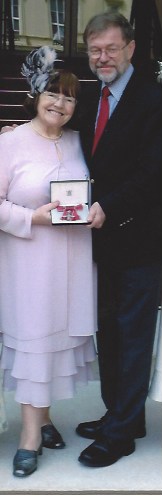
We were going to a birthday party, my Aunty Lily’s 90th. Lily has lived in Bury all her life, still manages well on her own, although her eyesight is failing. Well known in the town because of her lifelong voluntary work with schizophrenia carers, she received the MBE one day at the palace in 2006; I know this, because on my 62nd birthday I watched the HM pin it on her.

These days we don’t undertake such long drives: 175 miles over three and a half hours along two of the busiest motorways M1 and M6 – at least it was a Sunday. And we were late, having to stop for the loo at a Macdonald’s. ‘Oh,’ I said, ‘it doesn’t matter, we can just mingle surreptitiously.’ No chance. When we entered Elton Liberal club, the celebration was a sit-down job, with china cakestands, tablecloths, trimmed sandwiches and pots of tea. And there seemed over a 100 people, including the town mayor and his deputy in their chains and ties.

My sister and her West Yorkshire contingent of husband, son and daughter had kept places for us, so we were thankfully able to ease into the throng quickly but more publicly than I had wanted. Lily looked pretty amazing for her age and was infused with birthday pleasure. More formal that I had thought, speeches were delivered including my own one about the late 60s, when as a student I would take buses to Bury from Stockport and do the rounds of clubs and pubs with aunts Lily and Alice. Those events were not as alcohol-fuelled as separate outings with my Uncle Jack, who besides paying for my beer gave me half-a-crown for the and bus fare. Boundless was my gratitude since my grant was always much diminished; most likely both our as Jack was often on the dole.

Back to the tea party, where its time slot (hire-free to pensioners) was coming to an end, and we were to drive over the Pennines to my sister’s, where my niece was to have her own birthday do. We had a rushed goodbye with Lily, actually had to queue, and still she was lapping up being birthday girl.

As we drove away, I remembered how Dad hated going back to his home town. Memories of the Depression, unheated houses, outside toilets, horse-drawn moonlight flits, being fostered out for several years and once age 15, having run away to sea, his mother dragging him back for the pittance he earned from some god-forsaken job, all did not endear him. Thatcherism or a derivative of it administered the coup de grâce, and it doesn’t look much like I knew it 50 years ago, let alone almost a hundred.

This journey, into which I was rightfully pressed as family duty, reminded me of my paternal roots. Dad was 14 when The Road to Wigan Pier was published, a shocking glimpse of the living conditions of the British underclass (compare to the Grenfell Tower fire, 80 years later so – plus ça change). Lucky me to be born into the fairer socialism of postwar Britain; or not, because I don’t have a town to call home. And that’s Dad’s fault.
_____________________________________

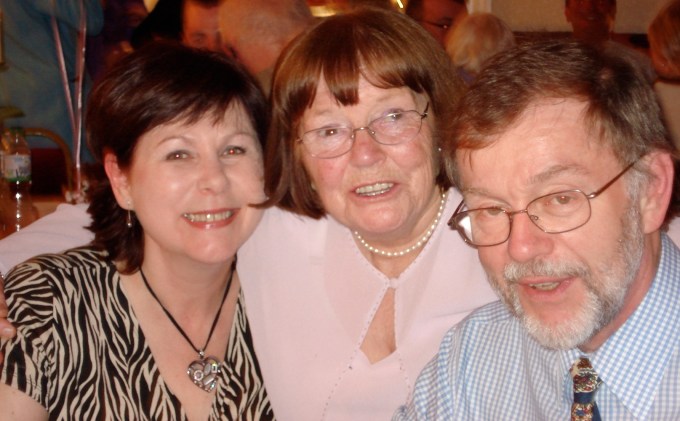
(Photo above is actually from Lily’s 80th birthday)

Scan.jpeg

Buckingham Palace, 2006

Reading in High Places

My career took place in business class,
Living out of an impossibly small
Roll-on that never saw the hold.

As a perk of this caper, I read novels,
Drank champers and ate
Smoked salmon that I got to hate,

Flew a day and a quarter from Sydney to
Delaware to the maw of corporate HQ, where
They talk a language I’ve guiltlessly discarded.

From London once, all day to the Caucasus
I read and drank the silences from
The empty seats beside me, fore and aft.

That afternoon the pilot banked obligingly
Over Istanbul to balance me above
Coppery glints of minarets and domes.

At darkening India, I fell asleep over
My third novel and dreamt of
Ants at prayers in mosques.

Ampthill
28 January 2008


At the Seaside

A friend has a grand Edwardian house in Westcliff-on-Sea, and generally comes to visit us because she and I walk, footpaths being handier here. On this occasion, we drove the 77 motorway miles to her one afternoon in May. She had also invited her daughter and two children so we had a sort of domestic afternoon, including a visit to the beach. A chilling wind blew off the flats, the two- and four-year-old indifferent to it, intent on patting sand, while the adults stood around in warm coats.

Leaving the others to themselves, I wandered off towards the Crowstone, something I had heard of but only seen its tip in the estuary waters. It’s a 14-foot-high granite obelisk with a history going back to 1197, but most recently re-erected in 1836 to show the seaward limit of the City of London’s jurisdiction over the Thames. Nosing around it alone, taking in the sea air, I remembered childhood days at the seaside on the Isle of Wight. When the little boy came up, I showed him how to skim stones off the water.

After the beach it was back to Camelot, for so is the house named, and for mum to get the children ready for bed and their sleepy car journey home to Bromley. I was roped in to read a story to the now pyjama-clad little boy, who had equipped himself with no fewer than three children’s books. Took me back 40 years, especially my own son being 44 that very next day. They don’t change: after three books were despatched, he waited for more. I asked, ‘Which one shall I read again?’ He chose Bear Hunt, an illustrated narrative by Anthony Browne, in which your ursine hero evades a pair of incompetent hunters by deftly drawing rescue devices with a pencil on the page. For example, a hunter advances behind with a noose and Bear draws a horn, which on the next page is at the end of a menacing rhinoceros. An interesting metafictional device that the lad couldn’t quite grasp when I put it to him.

Outside in the spacious garden, a mangy fox padded over the lawn. Later, Mr Grey, a tomcat of the same colour meowed at the back door for his tea. Mr Grey has a (bad) thing about men so I had to pretend that I wasn’t there, but he dashed in for his grub, and out again, eyes wide-eyed with distress.

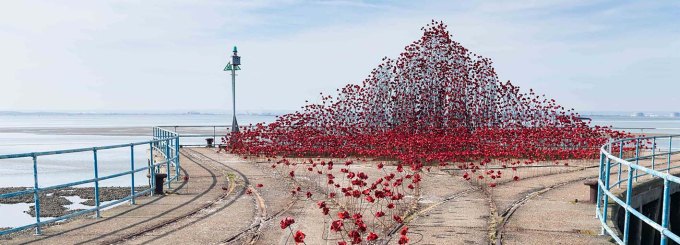
Next morning, the party reduced to three adults, we drove forth through Southend and beyond to Shoeburyness, the end of the train line to London. Here we walked up to Poppies: Wave a marvellous adaptation of the moving Tower of London remembrance poppies of 2014. At the end of a pier on MoD land, it’s on a UK-wide tour, a stream of bright-red poppies on stalks flowing towards the estuary. Lovely. You could leave a handwritten note to be displayed and laminated by red-poppy-coloured volunteers; on mine I wrote ‘Thanks to Dad, Sergeant Yates of The Black Watch 1942-1961’. (Dad went up Gold Beach on D-Day and wounded later, served in Germany, Korea, and Kenya where he was also wounded.)

To nearby Shoebury Garrison, set up for the Crimean War but now the defunct garrison’s buildings are rather posh residences. Driving around the development reminded me of my own life in barracks more or less until the age of 21, and how most of my old homes are not just defunct but demolished.

Back to Camelot for coffee, motor back to Ampthill.

_________________________

Poppies: Wave: http://www.visitsouthend.co.uk/poppies/poppies.aspxCrowstone: http://southendtimeline.com/crowstone.htm

Bear.jpg

Mussolini’s Gardener

I did not start serious hiking until I returned to live in my native country, in December 2004. Just a fortnight later on a black January morning at Devil’s Dyke, I was beginning the South Downs Way with a friend, now of fifty years. Since then I have completed the SDW, the Thames Path, Greensand Ridge Walk and John Bunyan Trail (both twice), besides extensive local walking in the pretty but flat local Bedfordshire countryside. All this for twelve years and the body holding up fairly well. Until now.

What has this to do with the infamous Benito? Another friend (isn’t it easy to mistype it as ‘fiend’?) of mine, a wag of sorts, and who doesn’t walk as much as I do, listened kindly enough to my tale of woe about the bad foot that has brought my walking to a stop. In fact, so stopped is it that my doctor has ordered only walking around the house, whatever that means: I am housebound, and for a month. That was ten days ago but I broke the rule a few days later when I struck out the almost two miles to the station and a suburban pub crawl in St Albans. Not a good idea, and since then I have followed the doc’s advice to a T.

Must hasten to the point. The wag likened my complaint to an imagined horticultural assistant to Il Duce. A painful condition of the heel, it’s called plantar fasciitis.

Mussolini.gif

Mothers-in-Law

Born in England on the first Christmas Day of the Great War, my first mother-in-law Gwen came into my life in 1966 (she died in 2005) when I met her daughter, my first wife. Betty, born in Australia in 1924, I first met in 1975 when asking for her first-born daughter’s hand. Betty died recently and I got to thinking about both my mothers-in-law. Why not a comparison?

Similarities

For most of their lives they were housewives, full-time mothers, both lived through the Second World War, in Betty’s case as a military dental nurse, but as for Gwen I do not know, she would have been 25 at the outbreak of WWII. Both had what might be termed successful husbands, Betty’s Ray a stock and station agent and owner of a concrete fabrication factory, and Gwen’s Francis an automotive engineer who designed the aerodynamics of Bluebird. (He went with Donald Campbell to Australia in 1964 for the ill-fated attempt on the world record.) Finally, in their own way both mothers-in-law were good cooks, from Gwen’s signal Scotch eggs to Betty’s famous recovery breakfasts at Hill Street and Prentice Avenue. And no mean feat for that generation, they both got into their nineties.

Contrasts

Betty was undoubtedly the matriarch of the family I had glimpses into, in her pomp strong and protective; Gwen was timid and submissive, especially to Francis who, tall but thin as a rake had a big booming voice that bespoke authority. Ray could never be described as submissive but he, like many, seemed to stand in Betty’s shadow. Oh, yes and I never remember religion even being mentioned at the bungalow in Rugby, quite different to the all-pervading Catholicism at Betty’s houses. Another big difference was that Gwen was strictly teetotal; my second mother-in-law was most assuredly not. Others were that Gwen had two daughters only and Betty produced eight children, but as Leslie Nielsen said in Flying High ‘that’s not important’.

Physically, Betty was tall, at least she seemed so to me, while Gwen was shorter although possibly her pronounced stoop made her so. Gwen rarely smiled, certainly I never remember her laughing, not as much as her successor, who was pretty jolly. (Round both, you had to watch your language, as you did for your own mum and dad.)

As an in-law, for what shall I remember each? For Betty her strength and generosity, for Gwen her quiet ways of handling difficulties (mostly to do with her husband), but in truth I didn’t know her as well as I did Betty, thus I am probably short-changing her.

Extra

I can’t resist something about the fathers-in-law, because long-married couples can re-shape each other. In the hour it took me to drive him once to Manilla (NSW) I learned from Ray what a long paddock was, e.g. that it doesn’t have a gate. So that’s a nice person to live with, someone who knows about long paddocks. On the other hand, one evening at the bungalow, finally Gwen and Frances went to bed leaving their daughter and me alone. Gasping for a fag but without a light, I reached down to the (faux) hearth for one of her dad’s Swan Vestas. ‘Don’t you dare,’ she cried, ‘he counts them.’

Finally

To both Betty and Gwen, may you rest in peace and I thank you for your daughters.

____________________________________


Amiens, February 2017

Monday the 6th of February and thrilled to be setting out for Eurotunnel, off the island and onward to Amiens. With a population of 136,000 it used to be the capital of the historical region of Picardy and sits astride the river Somme, which set against the ferocious battles fought there, is Celtic for ‘tranquillity’. Why Amiens for us? It’s an hour and a half’s drive from the Channel, nicely reachable compared with some of the other eight-hour treks into deepest Europe, getting too old for all that.

Well, the town isn’t bad, although much destroyed and rebuilt after two wars. For example, the train station (1857) was razed by German shelling in WWI, rebuilt identically, then Allied bombing destroyed it again. Now it is a thoroughly modern structure. Boasting a stunning Gothic cathedral, the biggest in France, Amiens was home to Jules Verne and where the Red Baron was brought down for the last time. We had a pleasant time attending the bars and restaurants. Pretty cold at 2-3° lots of the time but we don’t mind that.

What we did mind was the Airbnb-booked three-storey 18th-century gîte called La maison de Sophie in the St-Leu quartier, with an arm of the river Somme flowing languidly by. It all looked lovely on the website but when we arrived we were greeted by a posse of elderly French-speaking (actually, shouting) fisherman smack bang opposite the house, drinking the time from after 8 a.m. until dark, every sodding day. Lovely. Sophie’s was poorly maintained with a broken window lock, lights not working, an unanchored safety rope on the perilous stone spiral staircase, a filthy rubbish-bin area and an eyesore of a garden. Thoroughly poor value.

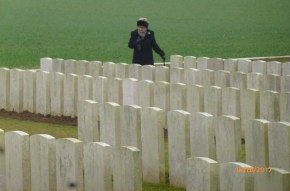
A longish walk through dubious streets to the Jardin des Plantes revealed nothing in the beds, and the greenhouses were strictly accés interdit. Well, it is February. Best part, aside from the truly lovely cathedral, were two days driving up and down the Somme, visiting villages, military cemeteries and other old stuff. Most notable was the British cemetery at Crouy, where the majority of headstones showed 248 Aussie war dead. In one corner of the cemetery stood a couple of dozen German graves, suitably but sadly divided from their former enemies. And another time we were at the site of the famous Australian victory at Le Hamel, recently been made into a moving, windswept war memorial to those unfortunate lads of a faraway country.

My lasting impression of the town was one of visible homelessness and poverty, and if you are unlucky enough to be victim of those, you are not persuaded by higher liberal values but of how to make ends meet. If you think Marine Le Pen will get that for you, why wouldn’t you vote for her? Much ado à la Trump.

Home in Ampthill after five days of all this, I almost kissed the carpet John Paul II-like, with thanks for a much-desired homecoming and rebalancing of our dosha.


Neglected Somme.JPG
Not quite Sophie’s!
Suzanne at Crouy cemetery.JPG
An Aussie amongst Aussies

Breakfasts


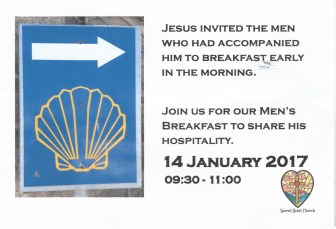
Possible attendance at men’s breakfast had always fostered velleity in me, until I buckled to the strenuous invitation from my Catholic deacon friend. It was to be the setting to present his epic 500-mile Camino pilgrimage; and it was going to help me a little since I was also editing his book on it. A couple of friends, to whom I had shown without comment, ‘Saturday – men’s breakfast’, in my diary, had each lifted an eyebrow, so no pressure then.

Yesterday I walked the just-over two miles to the church, located in Pope Close (yes). Under an overcast sky and wrapping-up weather of 2°, it took about half the distance for me to cognitively restructure enough to finish the second half. But by the time the unassuming modern brick and timber structure came into view I was back to steeling myself for the encounter. Inside, most of the men had arrived, happily standing about in jumpers and cardigans with mugs of the steaming proverbial. Having found my deacon to say hello, I saw with great relief that there was someone else I knew, a man who lives a street or so away from me, and importantly a fellow non-Catholic, and like me, married to one.

Half-a-dozen tables were laid out with paper tablecloths and a large plastic dispenser of tomato sauce. Pretty soon we sat down, I at a table with my neighbour, someone who works with St Vincent de Paul, and three others. After the La Faba pilgrimage prayer, a male hubbub sprang up similar to when I breakfasted at Peckham Spike* in 1965, but at that grim place tin plates of porridge ladled from dixies were slid with great force down to those at the ends of long trestle tables – keep your elbows up, boys! Here, on the other hand, three smiling women from the adjacent kitchen bore aloft salvers of sandwiches steaming with sausage and bacon, while a slim young man in a grey waistcoat walked amongst us with a coffee pot and milk jug, like an airline steward.

Thank goodness for the neighbour, a bloke I see from time to time, a few months younger than I, and formerly in the merchant navy. When the deacon started to talk and apologise for his neglecting to include music for the slides, I muttered almost to myself, ‘Well, could be a blessing.’ And the SVP-man grinned in agreement. Everyone attended to the deacon’s energetic photo and feelings presentation of his walk, while simultaneously relieving the plates of their munchy offering.

’Twas all not so bad, but then frequently things aren’t. With the presentation over, there were the usual questions that dragged things out enough to get my fingers drumming. Finally, my sailor-neighbour gave me a lift back during which, because he said he was going to Nottingham that day, I hogged the time mournfully reminiscing about picking up girls at the Sherwood Rooms dance hall, a couple of years before that other, homeless breakfast in South London. At last, my house’s warmth closed in on me wonderfully.

I’d done it! I’d survived men’s breakfast!

* see: https://vimeo.com/4042606

Scan 1.jpeg